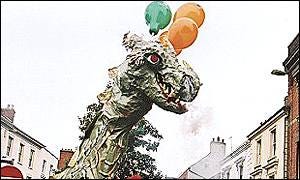
The Dinder Wyrm
A dragon with a human face

Wells is a small but beautiful city, graced by a large cathedral and the magnificent Bishop’s Palace. Back in the 13th century, Bishop Jocelyn of Bath and Glastonbury was one of the most powerful men in the country, influential in matters of state as well as the church. He was responsible for the building of the Bishop’s Palace in Wells, along with much of Wells Cathedral.
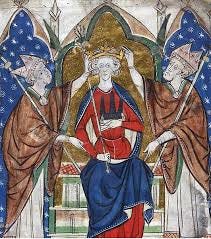
At one time an advisor to King John, he owned a great deal of land and property and was even a signatory on the Magna Carta.
While Bishop Jocelyn was busy overseeing the building works at the cathedral, a dragon, or wyrm (the ancient name for dragon) had settled nearby. The creature was terrorising the local population, devouring the children of the village of Dinder and other nearby villages. (Though some say it was only when it started eating livestock that the villagers got alarmed ).
Hearing of the dragon’s terrible exploits, Bishop Jocelyn determined to destroy the beast before it got any closer to his building works. He rode out towards Dinder, where the wyrm had its lair, along with a party of his men. Place names nearby - Worminster and Worminster Sleight (a hill above Dinder) - are possibly references to the existence of this dragon in the local landscape.
When they were a furlong from the village, Bishop Jocelyn commanded his men to stop, and bravely went ahead alone. He confronted the beast and slew it single handedly (possibly with his left hand - I’ll explain why in a minute). The Dinder wyrm was said to have a human face - and in some versions of the story, specifically a woman’s face. Apparently dragons with human faces were generally seen as female, possibly because the church blamed women for practically everything since Eve met the serpent in the garden of Eden.
Bishop Jocelyn had left his men behind and gone ahead alone, which means there were no witnesses to his battle with the human headed dragon. However, as no more was heard of the creature after the fight, people believed his account of what happened.
A medieval manuscript recording the event, Ranulf Higden’s Polychronicon, is held by Eton College library. They kindly sent me this copy of the relevant page:
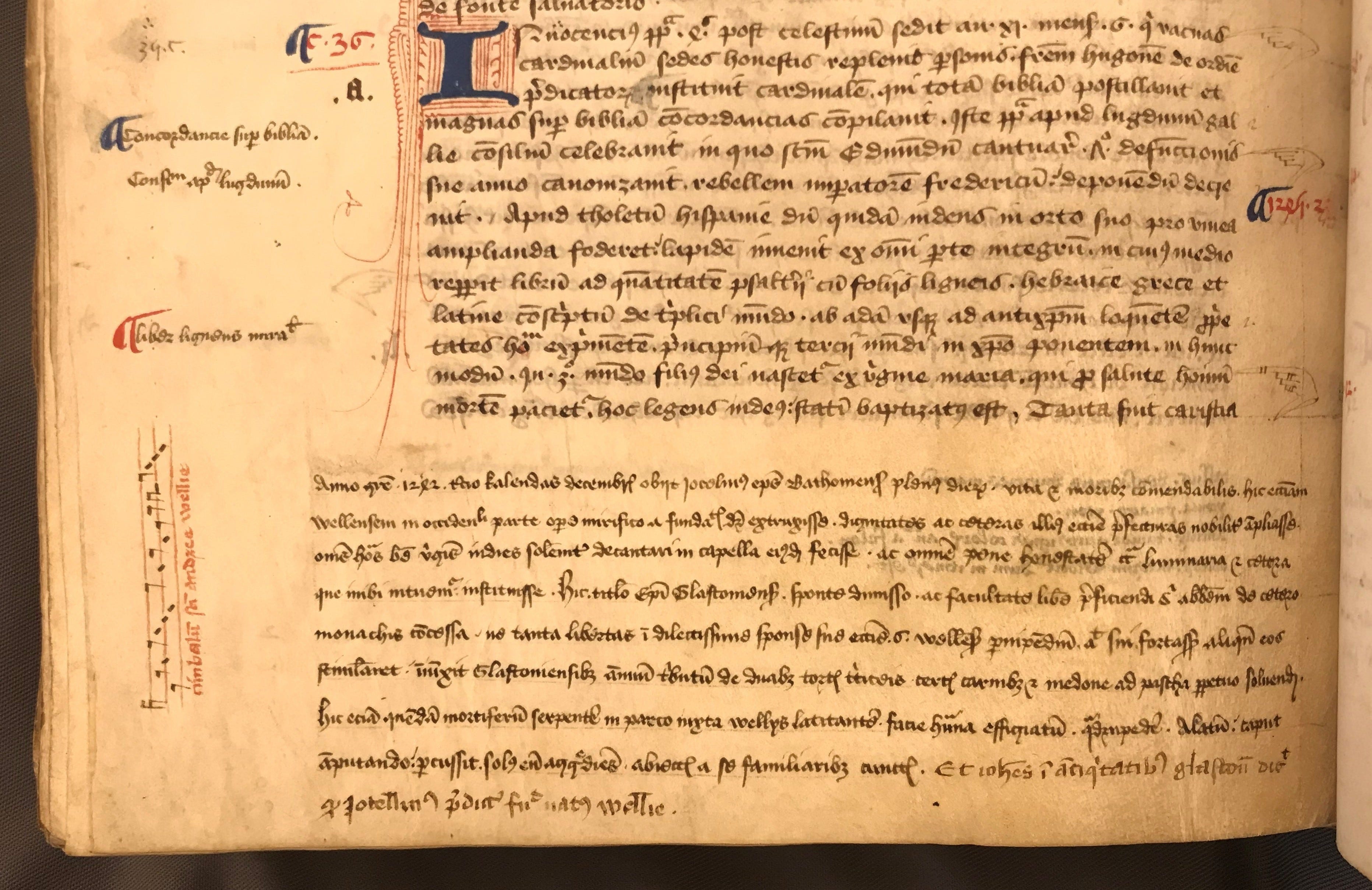
A transcript of the encounter of the event in the Latin text reads:
Hic eciam quendam mortiferum serpentem in parcio iuxta Wellys latitantem. Facie humana effigiatum. Quadrupendem. Alatum. Caput amputando; percusit. Soluseum aggrediens abiectis a se familiaribus cunctis.
This translation by Reverend Peter Thorburn, is from 2001:
He (Bishop Jocelyn) also slew a certain deadly serpent which lurked in the park (meaning countryside) near Wells; (it was) depicted as four footed and winged, with a human face. He dispatched it by striking off its head, engaging it in single combat after dismissing his entire retinue.
Of course this record doesn’t necessarily prove it happened, but definitely adds something to the story.
Since the original slaying in 1240, there has been a celebration held in the village of Dinder every 50 years to commemorate the event. The reenactments have to be performed by a left handed clergyman (was Jocelyn left handed? Maybe…), or the dragon will return. The last reenactment was held in 2001, so the next one will be in 2051. Some of us may not live to see that celebration, but I’m personally hoping there are no left handed clergyman available - and the wyrm with the human face returns.